

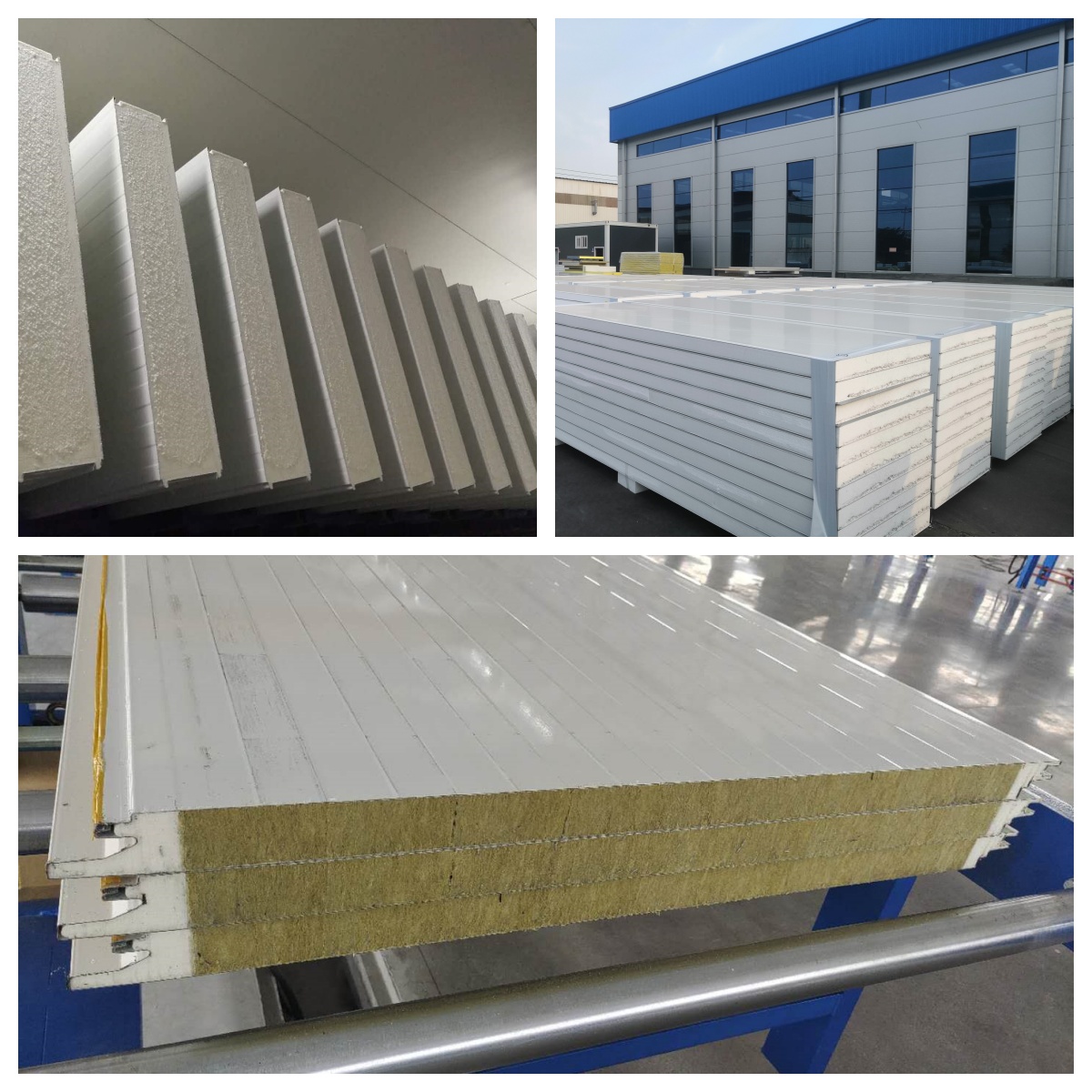
Choosing the right sandwich wall panel—EPS (Expanded Polystyrene), ROCKWOOL (Mineral Wool), and POLYURETHANE (PU/PIR)—depends on project type, local codes, environmental conditions, performance requirements, and budget. Each has unique strengths; the key is matching characteristics to project needs. Below is a step-by-step guide for industrial, commercial, and civil projects (e.g., warehouses, cold storage, factories).
Step 1: Prioritize Fire Safety Requirements (Non-Negotiable)
Fire safety is paramount for code compliance and safety. First, confirm the fire rating required by local regulations (e.g., EN 13501, GB 8624, ASTM E84):
- A-class non-combustible required: For public buildings, high-rises, factories with combustible materials, or strict fire audits.
- → Choose ROCKWOOL panel. Inorganic A1-class non-combustible (melted basalt/stone fibers), withstands over 1000℃ without melting or toxic gas, the only option for highest fire safety.
- B1-class self-extinguishing acceptable: For general warehouses, workshops, cold storage, and moderate fire risks (no open flames).
- → Choose POLYURETHANE (PU/PIR) panel. B1-class (self-extinguishing), low smoke, good fire resistance. PIR is more stable than PU at extreme temperatures, suitable for low-temperature projects.
- Low fire risk, budget-sensitive: For simple warehouses, temporary buildings, non-load-bearing partitions, or loose fire requirements.
- → Choose EPS panel. B2-class combustible (upgradable to B1 with flame retardant), low-cost, basic fire resistance. Not for high-risk scenarios (melts, drips, releases harmful gases when burned).
Step 2: Match Thermal Insulation to Project Temperature Needs
Thermal insulation depends on thermal conductivity (λ-value); lower = better. Select based on temperature requirements, which impact energy costs:
- Low-temperature scenarios: Cold storage, freezers, food plants (≤ 0℃, down to -40℃).
- → Choose POLYURETHANE (PU/PIR) panel. Lowest λ (0.019–0.023 W/(m·K)), dense closed-cell structure locks cold air. 50mm PU = 100mm EPS insulation, saving space for cold storage.
- Normal temperature scenarios: General warehouses, workshops, offices (0℃–30℃) with basic insulation.
- → ChooseEPS panel. Moderate λ (0.032–0.038 W/(m·K)), closed-cell (98% trapped air), cost-effective, meets most non-special needs, cuts 30%–50% heating/cooling energy.
- High-temperature scenarios: High-temperature workshops, boiler rooms (≥ 50℃).
- → Choose ROCKWOOL panel. Excellent high-temperature resistance (200℃–400℃ long-term), stable insulation. EPS/PU/PIR soften/decompose at high temperatures, unsuitable.
Step 3: Consider Acoustic & Environmental Conditions
Environmental factors (humidity, dust, salt spray) and acoustic needs affect service life and usability. Choose based on on-site conditions:
- Sound insulation required: Offices, high-noise workshops, road-adjacent buildings, quiet environments (hospitals, schools).
- → Choose ROCKWOOL panel. Fibrous structure absorbs sound waves; 100mm panels reduce noise by 30–50 dB, better than EPS/PU/PIR, ideal for noise-critical projects.
- Clean environment required: Clean rooms, pharmaceutical/food plants (dust-proof, easy-clean, no fiber shedding).
- → Choose POLYURETHANE (PU/PIR) panel. Smooth closed-cell surface, no fiber shedding, easy to clean/disinfect, airtight, meets food/medical hygiene standards.
- Humid/coastal/high-moisture environments: Coastal (salt spray), rainy regions, high-humidity projects (aquaculture, basements).
- → Choose EPS or PU/PIR panel. Closed-cell, good water resistance (EPS 90% hydrophobic, PU/PIR excellent).
- → ROCKWOOL absorbs moisture if unsealed (reduces performance); seal edges with PU foam if used in humid areas.
Step 4: Balance Budget & Structural Load
Budget and steel frame load-bearing capacity are practical considerations. Choose panels balancing cost and safety:
- Lightest weight (reduces steel load): EPS panel (12–20 kg/m³), followed byPU/PIR (35–45 kg/m³). Lightweight reduces frame load and cost; EPS (18 kg/m² average) is easy to transport/install (3x faster than traditional walls).
- Most cost-effective: EPS panel. Lowest material/installation cost (30%–40% cheaper than PU/PIR/ROCKWOOL), suitable for budget-constrained simple projects. Note: Inferior durability, consider long-term maintenance.
- Durable & fireproof (higher cost): ROCKWOOL panel (80–150 kg/m³, heaviest), requires stronger frame. Higher initial cost than EPS, lower than PU/PIR, long service life, ideal for high-risk long-term projects.
- Premium performance (higher budget): PU/PIR panel. Highest initial cost, best insulation offsets energy costs; cold storage savings recoup price difference in 2–3 years.
Step 5: Select Joint Type & Appearance
Joint type affects sealing, wind/water resistance, and appearance. Choose based on tightness, aesthetics, and installation efficiency:
- Good sealing, no exposed screws, modern appearance: PU/PIR panel (cam-lock/T&G hidden joints, rubber gaskets). Airtight, waterproof, clean look, suitable for cold storage, clean rooms, high-end industrial buildings.
- Cost-effective, simple installation: EPS panel (lapped/simple T&G joints, visible self-tapping screws). Low installation cost, simple operation; seal lapped joints with sealant (critical for rainy areas), suitable for temporary/ simple warehouses.
- Strong wind/typhoon areas: PU/PIR or ROCKWOOL panel (reinforced T&G hidden joints). Better rigidity/tightness than EPS; add anti-wind clips for typhoon areas. ROCKWOOL’s higher density enhances wind resistance.
Step 6: Adapt to Local Climate & Additional Requirements
Local climate and customization needs ensure long-term performance:
- Strong wind/typhoon areas: Avoid EPS (lightweight, wind-prone); choose PU/PIR/ROCKWOOL with reinforced joints. Check wind resistance rating, comply with local standards (ASCE 7, EN 1991, GB 50009).
- Coastal/salt spray areas: Choose PU/PIR/ROCKWOOL with anti-corrosion coatings (PVDF). EPS can be used with stainless steel/aluminum surface treatment.
- Large temperature difference areas: Choose PU/PIR (good dimensional stability, no joint cracking). EPS may deform slightly; ROCKWOOL is stable but less insulating.
- Customization needs: All panels customize thickness (50mm–200mm); PU/PIR/ROCKWOOL offer more surface material/color flexibility. EPS has standard RAL colors; PU/PIR has premium PVDF coatings.
Quick Decision Table (For On-Site Reference)
| Project Type | Recommended Panel | Key Reasons |
| Cold storage / Freezer (-20℃ to -40℃) | POLYURETHANE (PU/PIR) | Best insulation, low λ-value, low-temperature stability, airtight |
| Factory with strict fire code / Public building | ROCKWOOL | A1 non-combustible, high-temperature resistance, excellent sound insulation |
| Normal warehouse (budget-sensitive) | EPS | Cost-effective, lightweight, easy to install, meets basic insulation |
| Clean room / Food/Pharmaceutical factory | POLYURETHANE (PU/PIR) | Smooth, no fiber shedding, easy to clean, meets hygiene standards |
| High noise workshop / Office | ROCKWOOL | Superior sound absorption (30–50 dB reduction) |
| Coastal / Typhoon area | POLYURETHANE (PU/PIR) / ROCKWOOL | Good wind resistance, anti-corrosion, tight joints |
| High-temperature workshop / Boiler room | ROCKWOOL | High-temperature resistance (stable ≥50℃) |
| Temporary building / Interior partition | EPS | Lightweight, low cost, quick installation |
Final Key Rules
- Fire safety first: Prioritize ROCKWOOL (A-class) if required; avoid EPS in high-risk fire scenarios.
- Insulation first: PU/PIR for cold storage; EPS for normal needs; ROCKWOOL for high temperatures.
- Budget balance: EPS for cost-sensitive projects; PU/PIR for long-term energy savings; ROCKWOOL for fireproof durability.
- Adapt to environment: Match panel to local climate and project-specific needs (cleanliness, sound insulation).
Provide specific project details (type, location, fire code, budget, temperature) for exact recommendations (thickness, joint type, surface material).